
5-Year True Cost of Ownership (TCO) Simulator
Don't get fooled by upfront price tags or recurring rental traps. Adjust your household water consumption below to side-by-side compare the real 5-year financial spend of **Buying vs. Renting vs. 20L Water Cans**.
Step 1: Customize Your Household Parameters
Approx. 22.5 jars (20L) needed monthly
Determines membrane wear and filter replacement frequency
Select the upfront quality tier for your home machine
Step 2: 5-Year Side-by-Side Financial Breakdown
Buy RO Purifier + AMCs
Own your purifier; pay only for periodic filter replacement candles
Rent Smart Purifier
DrinkPrime / Livpure Smart monthly subscription model
20L Branded Water Jars
Bisleri / Kinley delivered water cans (scaled to daily usage)
UV/UF Purifier (No RO)
Gravity or inline UV/UF filtration without waste water
💡 Top Recommended Purifiers from Our 5-Year Analysis
Order these high-efficiency purifiers online with verified discount affiliate pricing.

Livpure GLO PRO++
Excellent choice for home use. Features RO+UV+UF technology with a 7 Liters capacity tank.

Aquaguard Delight Aquasaver RO+UV+UF+MC
Excellent choice for home use. Features RO+UV+UF technology with a 5 Liters capacity tank.
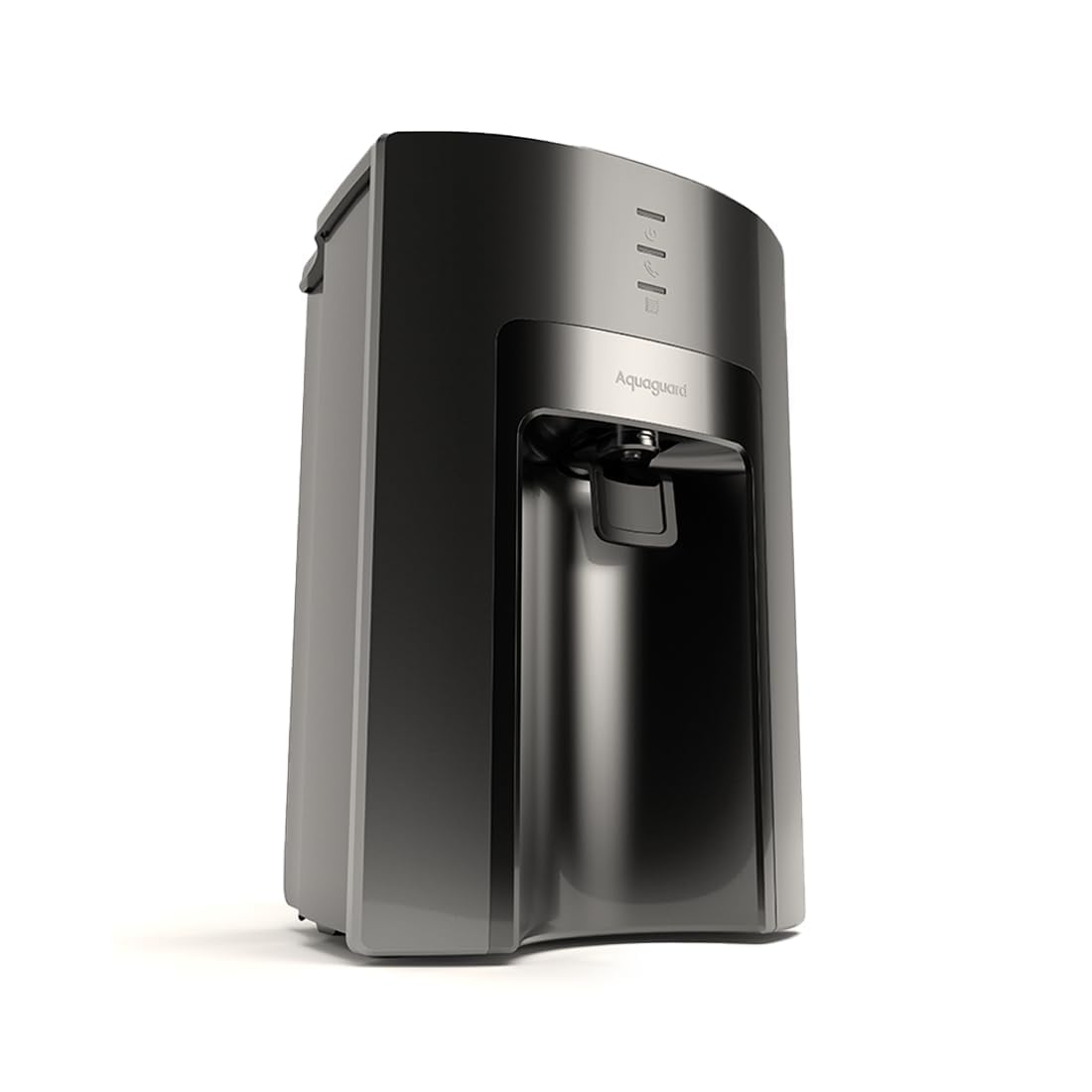
Aquaguard Delight NXT Aquasaver 9-Stage Water Purifier
Excellent choice for home use. Features RO+UV+UF technology with a 6.2 Liters capacity tank.
The Hidden Mathematics of Water Purifier Ownership
When purchasing a home water purifier in India, 72% of consumers make their decision based entirely on the upfront retail price tag on Amazon or Flipkart. However, a water purifier is not a passive appliance like a television or a refrigerator; it is an active biophysical filtration plant that consumes consumable cartridges, electricity, and water pressure every single day.
Understanding the **True Cost of Ownership (TCO)** requires evaluating three distinct financial components over a standard 5-year machine lifespan:
1. Upfront CapEx
The initial capital expenditure required to purchase the hardware, storage tank, booster pump, and installation fixtures.
2. Recurring OpEx (AMCs)
The ongoing operating expenditure required for spun polypropylene sediment candles, activated carbon blocks, RO membranes, and technician visits.
3. Opportunity & Risk Cost
The health risks of drinking through saturated membranes vs the astronomical markup of purchasing 20L plastic water cans.
Why Renting a Purifier Becomes a Trap After 18 Months
In recent years, smart subscription models like **DrinkPrime** and **Livpure Smart** have gained immense popularity among bachelors and tenants. Their value proposition is compelling: pay zero upfront cost and a predictable monthly fee (e.g., ₹399/month for 150 liters) that covers all filter repairs and maintenance.
While renting is genuinely the smartest financial choice if you live in a temporary rental flat for under 18 months, our TCO mathematical modeling demonstrates that **renting becomes significantly more expensive over a 5-year period**. Over 60 months, paying ₹449/month totals **₹26,940 in sunk rental payments**, whereas buying a top-tier ₹15,000 smart RO purifier and maintaining it with genuine ₹1,500 annual filter kits totals less than ₹23,000—leaving you with a high-value physical asset that lasts 8 to 10 years.
The 20L Water Can Illusion: India's Most Expensive Drinking Water
Millions of Indian households rely on 20-liter blue plastic water cans delivered by local vendors, assuming that spending ₹80 to ₹90 per can is cheaper than installing an RO plant. Our simulator exposes this mathematical illusion:
- **Volume Math:** A family of 4 drinking 3 liters each per day, plus consuming 3 liters for cooking and boiling tea/dal, requires 15 liters daily. Over 30 days, this equals **450 liters, or 22.5 jars per month**.
- **The 5-Year Drain:** At an average cost of ₹85 per jar, spending ₹1,912 per month translates to **₹22,950 per year and an astonishing ₹1,14,750 over 5 years**.
- **Quality Deficit:** Furthermore, over 65% of unbranded local water cans test positive for bacterial contamination or microplastic leaching due to jars being scrubbed with harsh industrial chemicals and reused up to 100 times under direct sunlight.
💡 E-E-A-T Expert Recommendation
*"If your municipal water TDS is below 300 PPM, do not waste money on an RO purifier or 20L cans. Install a basic ₹6,000 inline UV+UF purifier. If your borewell TDS exceeds 500 PPM, invest in a premium RO+UV system with a mineralizer cartridge. You will recover your investment within 9 months compared to buying water cans."*
— Praveen, Certified Water Quality Specialist
Not sure what to buy?
Get a free consultation and price quotes from local water purification experts.
Your data is secure and never shared.
Need expert help?
Stop guessing. Use our smart tools to calculate exact costs, check water quality, and find the perfect purifier for your home.
Frequently Asked Questions (FAQs)
Everything you need to know about water purifier maintenance costs and ownership math.
What is the True Cost of Ownership (TCO) of a water purifier?
Is renting a water purifier cheaper than buying an RO with AMCs?
Why are 20L branded water jars so expensive over 5 years?
How can I reduce the annual maintenance cost of my RO purifier?
Next Steps: Free Water Tools & Guides
Continue your research with our interactive calculators, AI assessment, and expert buying guides.
Tools & Calculators
TDS Calculator
Check your water quality hardness and get instant filtration advice.
Smart Purifier Catalog
Browse our full catalog of water purifiers with advanced filtering.
5-Year TCO Calculator
Compare long-term costs of Buying vs Renting vs Water Jars.
Maintenance Estimator
Avoid AMC traps and calculate your exact 5-year filter replacement costs.
AI Water Advisor
Take our 30-second quiz for personalized purifier recommendations.
Top Blog Posts & Guides
Top 10 Purifiers in India
Lab-tested rankings of 2026's best purifiers with 5-year AMC costs.
Best RO for Borewell
High-TDS purification systems tailored for hard borewell water.
Best for Municipal Water
Low-maintenance UV/UF purifiers for municipal corporation supply.
How to Remove Iron and Yellow Stains from Borewell Water Before RO (2026 Guide)
Is your borewell water turning yellow and staining clothes? Learn how to remove dissolved iron before it permanently destroys your expensive RO membrane.
The Physiological Health Benefits of Clean, Mineral-Balanced Drinking Water
An exhaustive clinical review of human cellular hydration, renal waste clearance, and electrolyte equilibrium. Discover how AI water matching protects multi-generational health.
Comments & Discussion
0 Comments